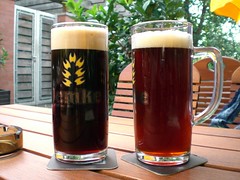
Beginner's Luck Brown Ale

Posted by Bens Stuff | 12:01 AM | | 2 comments »


Photo by:mfjardo


This recipe can be found at Beerrecipes.org
Ingredients:
  • 4 lb malt extract syrup
  • 6 oz crystal malt
  • 1.5 oz black malt
  • 2 oz roasted barley
  • 1 oz flaked or rolled barley
  • 1 oz wheat malt
  • 2 oz Northern Brewer hops
  • 1 oz Goldings hops
  • 28 oz dark brown sugar
  • 2 oz lactose
  • ale yeast
Procedure:
Hops: these are two of the six or so types available here in the UK; I'm afraid I don't know what the US equivalents would be because I've been brewing only since my transplantation from the States in early '92. [If anyone knows a reasonable set of hops equivalencies, I`m all ears.] Northern Brewer is a very sharp hop that is a prime-requisite for British dark beers and stouts (and some pale ales); Goldings is a much "rounder" hop that is a prominent component of southern-English bitters. US brewers use yer best guesses, I guess. Procedure: I treat my water with 0.25 tsp salt per gallon to adjust pH; the water here (Bristol, in the SW) is fairly soft by UK standards but contains some dissolved CaCO3. I have had no difficulties whatever using tap water. I dissolve the malt extract and then boil the adjunct grains + hops in it for about an hour. I then strain a couple of kettlesful (kettlefuls?) of hot water into the primary through the spent grains and hops to rinse them. I dissolve the sugar in a couple of pints of warm water and add this to the wort, then top up with cold water to 5 gallons. When the wort is cool, I then measure OG (usually about 1035 to 1039), then add the lactose and pitch the (top-fermenting) yeast. The lactose gives just a hint of residual sweetness in the final brew; if that's not to your taste, omit it. This brew ferments to quarter-gravity stage in about 3 days when temperatures are about 20C (70F) and in about 5 days when temps are about 10C (mid-40s F). Final gravity is usually about 1005, resulting in ABV's of 4.5 to 5%. I prime my secondary fermentation vessel with about 1 tsp of dark brown sugar, and usually let it sit in the secondary 7 to 10 days, adding finings after the first 48 hours or so. I have not tried dry-hopping this recipe. I prime my bottles with 1/2 tsp of brewer's glucose; maturation is sufficiently complete in about 10 days, but obviously the longer the better.


Have New Posts From Beer Recipes Delivered To Your Email

Oysters With Migonette

Posted by Bens Stuff | 12:01 AM | | 0 comments »

Pairing Beer With Food Series


Photo by:ExperienceLA

This simple recipe can be found on page 36 of Great Food, Great Beer.  They recommend a dry stout with the recipe and you might want to make this oatmeal stout to go with it.

1/4 cup champange vinegar

1/4 cup fresh lemon juice

2 tablespoons freshly grated horseradish sauce

2 tablespoons minced shallots

1/2 teaspoon sugar

salt and pepper

1 dozen oysters on the half shell.

In a small bowl, combine the vinegar, lemon juice, horseradish, shallots and sugar, whisking until blended.  Season to taste with salt and pepper.  Serve as topping for the oysters.


Have New Posts From Beer Recipes Delivered To Your Email

Holiday Porter

Posted by Bens Stuff | 12:14 PM | , | 5 comments »


Photo by: James Cridland


Beer Style: porter, spiced beer
Recipe Type extract

Description:

All the beer I make is from dry malt extracts and specialty grains. I don't have the time to do, or the space to set up for, all grain brewing.

I like to use Maple Syrup if possible (if I've got the cash, about $7 a quart) for dark beer. Not for the flavor, as a quart doesn't effect flavor much if at all, but because I've found it enhances attenuation, how complete the fermentation ends (something in it the yeasties like). The beer generally ends up more "dry" if I use maple syrup. I like clean malt character without sweetness. The beer I'm describing ferments out to 1.004, that is a clean ferment for the amount of grains used.
Ingredients:

* 3 lbs Amber Dry Malt Extract
* .25 lbs Black Patent Malt, crushed
* .5 lbs Chocolate Malt, crushed
* .5 lbs 60 lovibond Crystal, crushed
* .5 lbs Klagus 2 row malt, crushed
* .5 lbs Roast Barley, crushed
* 1 quart Grade C Amber Maple Syrup
* 2 oz Perle hops, pellets
* 1 pkg Whyeast Scottish Ale liquid yeast
* 2 Tbs Cinnamon
* 2 Tbs Allspice
* 2 Tbs Cloves
* 1 Tbs Nutmeg

Procedure:

Put the grains in a BIG grain bag so they have plenty of room to allow water to flow between after they swell up. Put the grain bag in the cold water and bring the heat up to 160 degrees F. "Steep" the grains like a big teabag. Mix the grains around by squishing the outside of the bag with a spoon, lift the bag out to drain the water with the goodies into the pot. Mix squish and drain the stuff every 5 minutes for an hour. DON'T let the temperature exceed 170 degrees F during the steep to keep tannin extraction (creates a bitter flavor, especially with roasted and black grains) to a minimum. Pull out the grains and set them in a colander that hangs in the rim of your pot and pour a half gallon of clean water through them (preferred), or put them in a colander in a bowl so you can capture the stuff that runs out and add it back to your boil.

I use pellet hops. Keep them in the fridge and use them as soon as possible. When done steeping the grains I add the first batch of hops (1 oz for this beer) and bring the water to a boil. Turn off the burner, add the Malt extract and stir it in till completely dissolved. Turn the heat back on, bring to a boil and check the clock. Depending on style you'll add different hops at different times. This recipe calls for 1 oz Perle at 60 minutes and 1 oz Perle at 30 min. You put the 60 min oz in first, then when there is 30 min left to the boil you add the second oz (add the spices here and maple syrup at end of boil for this beer). Boiled hops add the bittering character, some recipes call for hops at end of boil (sometimes called knockoff) which add aromatic character, some at transfer to secondary which really contributes to herbal or floral aromatics. A note regarding the boil, though a watched pot never boils, an unwatched pot of boiling wort will boil over - WATCH IT.

Cooling and Transferring to Primary: Folks use all kinds of containers and techniques to cool and ferment, its a matter of choice. This is what I do. Transfer the pot to my kitchen sink, fill the sink with ice and cold water. Put 2 gallons of fermentation temp water (yes I chill water for lagers, I have been called compulsive) in a sanitized bottling bucket. Add the wort when it is cooled to fermentation temp and add water to 5 gallons (measure and make gallon marks on the outside of your bucket using tap water). I fill the bucket to about 1/2 inch above the 5 gal mark because the valve at the bottom of the bucket is about 1/2 inch above the bottom. Let it set for 30 minutes for solids to settle to the bottom of the bucket. Drain the wort into a 5 gal carboy leaving the solids (trub) at the bottom of the bucket. I use glass to keep characteristics from the last fermented batch, which plastic can retain, from getting into the next batch. Add (pitch) the yeast starter and set up a blow off tube.

Primary Fermentation: When the yeast starts working you'll get a bunch of foamy gack (krausen) blowing out the tube. When the krausen subsides replace the blow off tube with an airlock. When the airlock activity slows (one bubble in 2 seconds for ale temp, one in 6 seconds for lager temp) use a racking tube to transfer (siphon) the stuff to a secondary fermentation carboy splashing as little as possible to minimize oxygenation.

Secondary Fermentation: Here's where you add dry hops for secondary, sometimes spices or fruit. At lager temps I prepare hop pellets by boiling 16 of water, adding the pellets to the hot water, and pouring the green goo into the secondary fermenter before racking. At low temps pellets can float around the top like rabbit pellets and never really break up. At ale temps just toss them in. The action of racking often adds a trace of oxygen, fermentation picks up just a little, and/or forces some carbon dioxide out of solution, and the airlock activity may pick up a little.

I do a secondary fermentation primarily for dry hopping and to help clarify the final brew (my beers normally have a light dusting of yeast at the bottom when finished instead of a 1/4 inch of murk found in some homebrews). I let it set a day or two after fermentation is complete and the hops (if I used any have settled). Rack to the bottling bucket and DON'T SPLASH - minimize oxygenation. If I dry hop I have a fine nylon netting which I sanitize and put over the end of the racking cane before transferring to the bottling bucket.

Bottling: Carefully add 3/4 cup corn sugar boiled in 16 oz water to the bottling bucket and stir without splashing with a long sanitized spoon getting agitation from top to bottom of the bucket to ensure consistent priming. Bottle it.

Bottle Conditioning: Bottle condition, to develop carbonation and such, at the appropriate temperature. Room temp for ale, lager temp for lager. Ales need 1 1/2 to 2 weeks (sometimes less if you're desperate), lagers from 3 to 4 weeks.

This is my beer making ritual. I've been doing it just like this for over 3 years with never a spoiled batch. Always drinkable, often great, and sometimes excellent results. Every experienced homebrewer develops their own brewing rituals and preferences for ingredients and equipment. The matter of which is better is largely subjective.
Submitted by: Daniel Fernandez

Source: Beerrecipes.org

Have New Posts From Beer Recipes Delivered To Your Email